


If you’ve been thinking about selling on Amazon but feel overwhelmed by all the conflicting advice out there, this post is for you.
I’ve spent months researching this platform, deeply studying real seller case studies, analyzing what works in 2026, and documenting the patterns that separate sustainable Amazon businesses from the ones that fail in the first three months.
I’m not an Amazon seller myself.
My background is in web design, SEO, and content, but as someone who helps women build online businesses from home, I wanted to understand this model thoroughly so I could share what actually matters.
These are the 10 most important lessons I’ve found, and I hope something here saves you time, money, or both.
Is It Still Worth It to Sell on Amazon in 2026?
Before diving into the lessons, I want to answer the question I get asked most often and give you an honest answer, not just a motivational one.
Yes, selling on Amazon is still profitable in 2026.
More than half of online transactions in many markets still happen on the platform.
Data shows around 65% of sellers are profitable, with average margins sitting between 15 and 20% (source: Jungle Scout State of the Amazon Seller Report)
So the opportunity is real.
But here is what has changed.
Amazon in 2026 is no longer beginner-friendly in the way it used to be.
Advertising costs have risen.
Fulfillment fees have increased.
Competition is stronger, and the sellers who used to succeed by simply uploading a product and running basic ads are now struggling because that approach no longer works.
What I have observed is that Amazon is not saturated with products.
It is saturated with sameness.
Copy-paste products with no differentiation fail quickly.
Generic listings without strong branding get lost, and businesses built around quick money rather than long-term systems fall apart when things get difficult.
The sellers who are still winning treat Amazon like a real business.
They do serious product research.
They build brands, not just stores.
They manage margins carefully and improve consistently over time.
For those people, Amazon is still one of the most powerful platforms available.
If you approach it with patience and strategy, it can absolutely work.
But if you treat it like a shortcut, it will frustrate you fast.
That is the honest truth, and it is the foundation everything else in this article is built on.
Why Start an Amazon Business in 2026?
When I first started researching online business models, Amazon kept coming up everywhere.
At first I thought it was just marketing.
But as I heard more and more real stories from entrepreneurs running e-commerce businesses on the platform, I started to understand why so many people still choose it and why it continues to make sense even in a more competitive environment.
The reach is the most obvious reason. Amazon has millions of active users searching for products every single day.
That means you are not starting from scratch when it comes to traffic and demand.
The customers are already there, actively looking to buy.
For someone starting out, that removes one of the biggest challenges in business, which is building an audience before you can even sell anything.
Beyond reach, the infrastructure is genuinely impressive.
With programs like Fulfillment by Amazon (FBA), you can send your products to Amazon’s warehouses and let them handle storage, packing, shipping, and even customer service and returns.
That removes a huge layer of operational complexity that typically overwhelms beginners.
Instead of figuring out logistics, you can focus on the things that actually grow a business: product selection, branding, and marketing.
Another thing I appreciate is the flexibility.
You do not need a large upfront investment to start.
You can test with a small number of products, see what works, learn from what does not, and expand gradually.
That kind of room to experiment without catastrophic risk is not easy to find in traditional business models.
And the long-term potential is real.
Sellers who build strong product lines, develop recognizable brands, and consistently optimize their listings can scale into something genuinely significant.
It takes time, but the platform supports that kind of growth in ways that many other channels simply do not.
For me, Amazon is not about fast money.
It is about using a powerful existing system in a smart and intentional way and building something step by step on top of it.
READ MORE – Start Smart: A Multi-Passionate Businesswoman’s Blueprint for Success
The 4 Main Amazon Business Models (And How to Choose)
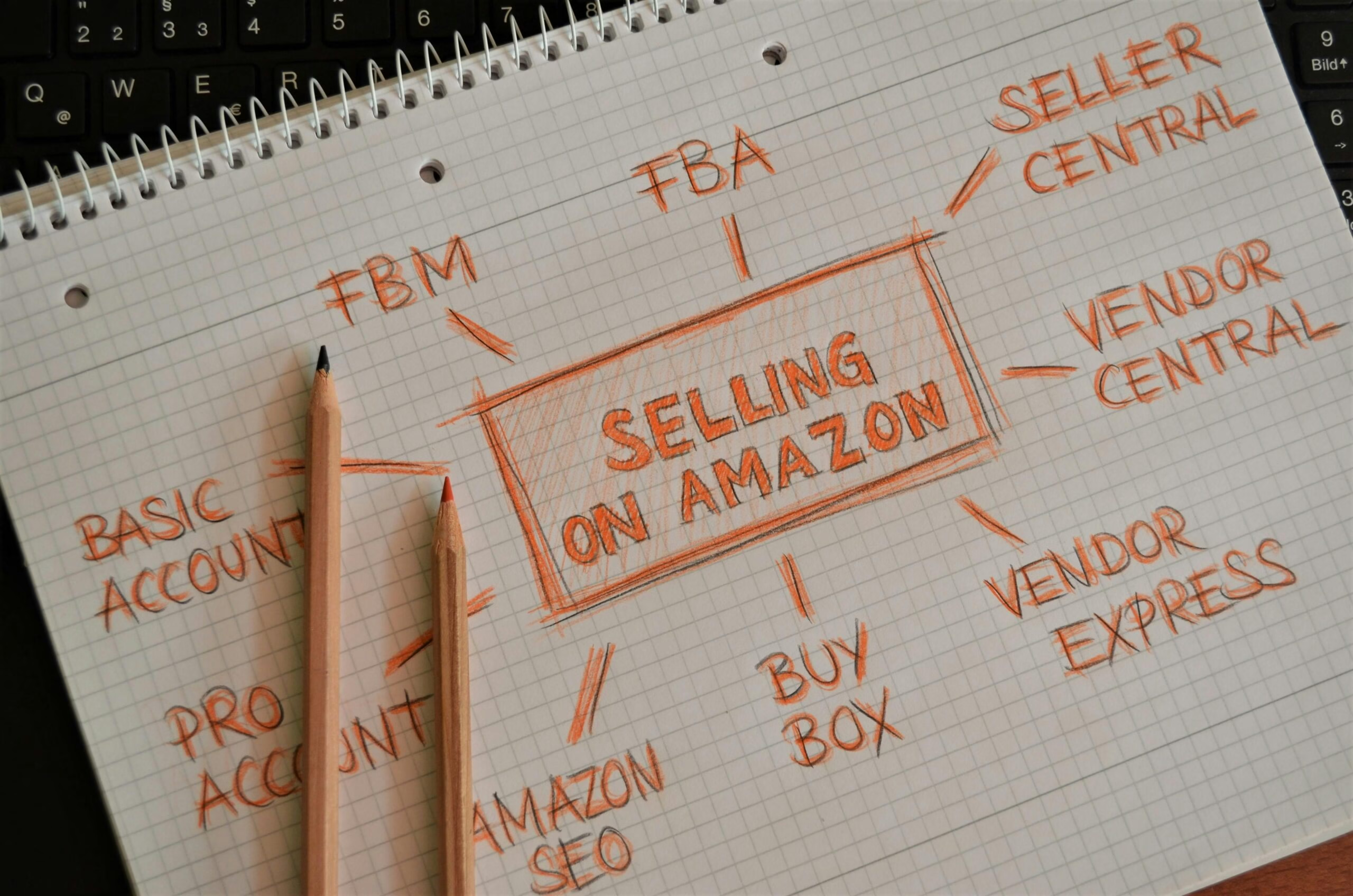
One of the first things I had to understand was that Amazon is not just one business model.
It is a complete system where you can choose how you want to operate based on your budget, skills, and goals.
Trying to understand all of them at once is overwhelming, so let me break them down clearly.
Amazon FBA (Fulfillment by Amazon) is the most popular model, and I can see why. You send your products to Amazon’s warehouse, and they do everything—packing, shipping, customer service, and returns. It feels more like building a system than running a day-to-day operation. The trade-off is that there are storage and fulfillment fees, and the competition is strong. If you want to succeed with FBA, focusing on private label (building your own brand) makes a significant difference over just reselling generic products.
Amazon dropshipping attracts beginners because of the low startup cost; you list products, and when someone orders, a supplier ships directly to the customer without you ever holding inventory. It is simple on the surface, but the margins are lower, Amazon has strict rules about it, and supplier reliability matters enormously. If your supplier delays or ships poor quality, your account takes the hit.
Amazon Wholesale is more of a traditional business model. You buy proven products in bulk from brands or distributors and resell them on Amazon. The advantage is that you are selling something people already buy. The challenges are that you need upfront capital, finding good suppliers is not easy, and you are competing on the same listings as other wholesale sellers.
Amazon Merch (Print-on-Demand) connects creativity with business. You upload designs, and Amazon prints and ships them when orders come in. No inventory, no upfront cost, and real passive income potential, but competition is high, and success here comes from focusing on specific niches rather than uploading random designs.
What I’ve come to realize is that success doesn’t come from the model itself.
The execution does.
My advice is to choose one model that fits your current resources and personality, understand it thoroughly, and build from there rather than spreading yourself across multiple approaches at once.
READ MORE – Online Jobs vs. Online Businesses: Which Is Better for Your Financial Future?
Here are 10 Powerful Lessons I Learned Growing an Amazon E-Commerce Business in 2026
Lesson 1: Choosing the Right Product Is Everything
I realized very quickly that everything starts and ends with the product.
You can improve your listings, run ads, and work on branding, but if the product choice is wrong from the beginning, nothing really moves in the right direction.
I used to pick ideas based on what “felt” like it could sell, but feeling is not a strategy.
Now I focus on actual data and real demand.
Tools like Helium 10 and Jungle Scout help me understand what people are already actively buying.
Google Trends helps me see whether interest in a product is growing or fading.
These tools do not guarantee success, but they anchor decisions in reality rather than assumptions.
Over time, I simplified what I look for.
I only seriously consider a product if it has consistent demand, is not already dominated by huge established brands, solves a real and clear problem, and still leaves room for healthy profit after all Amazon fees and costs.
If a product doesn’t satisfy me with all four of those points, I don’t force it.
Forcing the wrong product only leads to frustration and wasted money later.
The mistake I see most beginners make is chasing what looks “trending” without deeper analysis.
Something might be selling well right now, but the competition could already be too intense, the margins too thin, or the peak of interest already passed.
The goal is not to find what is hot this week.
The goal is to find something that makes sense for the next 12 months.
That longer-term thinking is what changes product selection from guessing into a real strategy.
Pro Tip: Before you invest in any product, check its Amazon Best Sellers Rank (BSR) history, not just the current number. A product that ranks well consistently over many months is far safer than one that had a single viral moment. Tools like Keepa or Helium 10 show BSR trends over time and are worth learning early.
Lesson 2: Market Research Saves You from Expensive Mistakes
I have seen far more people fail because of poor research than because of low budget.
That observation completely changed how I think about starting any business move.
If the product or idea is wrong from the beginning, money does not fix it.
It only makes the mistake more expensive.
Real success starts before you spend anything; it starts with understanding the market you are walking into.
Before I take any idea seriously, I try to answer a few basic questions first.
What are people already searching for?
What are the problems they are trying to solve?
What products are already performing well, and where are the gaps?
This kind of thinking gives me direction before I make any financial commitment.
Without it, everything feels like guessing.
Most beginners skip this step completely.
They get excited, pick a product, invest money, and hope for the best, but hope without direction is just expensive trial and error.
The problem for most of these people is not lack of effort.
It is a lack of information before taking action.
What research actually does is protect you from unnecessary failure.
It helps you understand whether demand is real or just temporary, whether competition is too strong to enter profitably, whether margins actually work once all costs are calculated, and whether a product has staying power beyond the first few months.
Once I started doing this properly, my decisions became more confident and far less emotional.
I stopped falling in love with ideas and started evaluating them instead, and that shift alone made a big difference.
Lesson 3: Branding Matters More Than Most Beginners Realize
I used to think branding was something you focused on later after you were already selling and had money coming in.
Over time I realized that thinking was completely backwards.
On Amazon, there are usually many sellers offering similar products.
So the real question is not “Does my product work?”
It is “Why would someone choose mine?”
Branding is the answer to that question, and it is not about logos or color palettes, even though those matter.
Branding is how people feel when they encounter your product.
It is the trust they associate with your name.
It is the consistency they notice across every touchpoint from your listing images to your packaging to your product descriptions.
When I look at successful Amazon sellers, I notice a clear pattern.
They are not just selling products.
They are building identity.
Their listings feel consistent.
Their products feel connected.
Their store feels intentional rather than random, and that intentionality is exactly what builds the kind of recognition that leads to repeat customers and word-of-mouth growth.
Most beginners ignore branding entirely because they are too focused on getting their first sale, but random-looking stores are easy to forget and easy to replace with a competitor who looks more trustworthy.
The sellers who build real brands on Amazon understand that every visual and every word is either adding to or subtracting from customer trust.
When you start thinking about your store that way, the decisions become much clearer.
Branding is not built in a day.
It grows through repetition, consistency, and genuine quality over time, but the earlier you start thinking about it seriously, the stronger your competitive position becomes.
Lesson 4: Your Product Listing Can Make or Break Your Sales
People do not buy the best product on Amazon.
They buy the product that looks most convincing on the page.
That realization changed how I approach every single listing.
Your listing is not just a description.
It is your salesperson, and they have to do all the work without you being there.
If it is not clear, compelling, and trustworthy, you lose sales even when your product is genuinely good and on Amazon, where customers are scanning and comparing multiple options in seconds; first impressions decide almost everything.
I used to think stuffing titles with as many keywords as possible was the right approach, but clarity matters more than keyword density.
A good title should tell people exactly what the product is, who it is for, and why it matters, all in a way that reads naturally.
If someone is confused after reading your title, they will not click, and if they do not click, nothing else matters.
Images are where most beginners underinvest.
On Amazon, images sell the product before words ever do.
Customers want to see how it looks from multiple angles, how it is actually used, and what makes it different from similar options.
A strong image set communicates more than a long description ever will, and it does so in a way that builds confidence fast.
Descriptions and bullet points should remove doubt, not just list features.
A good description anticipates the questions a skeptical buyer would have and answers them directly.
It should feel simple, honest, and helpful, not like it was written to fill space.
When I started thinking of a listing as a complete story that guides someone from initial interest through to confident purchase, my conversions improved noticeably.
That shift in perspective from “information page” to “sales conversation” is one of the most practical improvements any seller can make.
Lesson 5: Pricing Strategy Directly Impacts Your Profit
I used to think pricing was simple: add a margin on top of your cost, and that is it.
I quickly realized that pricing is far more strategic than that and that getting it wrong affects everything from how customers perceive your product to whether your business is actually sustainable.
Price is not just a number.
It is also psychology.
Customers do not always choose the cheapest option; they choose the option that feels worth it.
So if your pricing is misaligned with your positioning, even a genuinely good product can struggle to convert.
The calculation I used to do, cost plus margin equals selling price, ignores too many important factors: competition pricing, perceived value, market expectations, and Amazon’s own fees.
A more useful approach is to look at pricing as a balance.
You need a price that feels fair and reasonable to the customer, that leaves you with enough profit to reinvest and grow, and that matches how you have positioned your product compared to competitors.
Underpricing might seem like a safe strategy, but it often backfires.
If the price is too low, customers may assume the product is low quality, especially on a platform where price signals value, and even if you get sales, your margins may be too thin to scale or absorb any unexpected costs.
Overpricing without clearly communicating the value behind it causes the opposite problem.
A higher price on Amazon has to be justified immediately by better images, better reviews, or a better listing where people can scan multiple listings in seconds.
The shift that helped me most was moving from “How many sales can I get?” to “Is this price actually sustainable for my business?”
Sales without healthy profit do not build anything long-term.
Profitability is what allows you to keep improving, reinvesting, and growing, and that is the only version of an Amazon business worth building.
Lesson 6: Customer Reviews Build Trust in Ways Marketing Cannot
People do not just buy products on Amazon.
They buy trust, and in 2026, that trust comes primarily from reviews more than from advertising, more than from listings, and more than from brand recognition for most sellers.
Most customers do not read every detail of a listing.
They scroll, compare, and then immediately look at the reviews.
Because reviews answer the one question every buyer has in their mind: can I trust this product?
If the answer from other customers is clearly yes, the purchase happens.
If there is doubt, whether from low ratings, few reviews, or concerning feedback, they leave and buy from someone else.
Even genuinely high-quality products struggle if they have no social proof.
Reviews function as real experiences from real people, and that kind of third-party validation matters more to a hesitant buyer than anything the seller themselves says about the product.
This is why I no longer think of reviews as just feedback.
They are a public record of your product’s reputation, and they directly influence both buying decisions and search ranking.
Products with strong, positive review histories perform better in Amazon’s algorithm, which means more visibility, which means more sales.
It all compounds.
Building a strong review profile takes time and cannot be rushed.
It starts with consistent sales and then with the quality of the actual experience you deliver: product quality, honest listing expectations, good packaging, and follow-through.
The sellers who focus on engineering a great customer experience inevitably build better review profiles than those who focus on asking for reviews aggressively.
The reviews are the result.
The experience is the cause.
Lesson 7: Marketing Is Not Optional, Even on Amazon
I genuinely believed for a while that a good product would find its audience naturally.
Amazon is such a large marketplace, I thought, so surely visibility would follow quality.
That is not how it works at all.
Amazon is a highly competitive marketplace where thousands of products compete for the same search terms and the same customer attention.
If you are not actively promoting your product, someone else is.
Without marketing, even excellent products stay invisible, and invisible products do not sell.
Amazon’s own advertising tools, particularly PPC (pay-per-click) ads, are one of the most direct ways to put your product in front of people who are already searching for what you sell.
But I learned something important about ads: they only work when your listing is already strong.
If someone clicks your ad and lands on a weak listing with poor images and an unconvincing description, the ad spend is wasted.
Ads amplify what is already there; they do not fix underlying problems.
External traffic matters too, and I think this is something many Amazon sellers underutilize.
Bringing potential customers from platforms like Instagram, Pinterest, TikTok, or YouTube creates familiarity before people even reach your Amazon page.
When someone has seen your product multiple times across different contexts, the purchase decision becomes much easier.
Content blog posts, short videos, and helpful guides build this kind of long-term visibility without the direct cost of ads, though it requires consistent effort over time.
The most important mindset shift for me was accepting that marketing is not a separate step you add after you have set everything else up.
It is a core part of the business from day one.
A product without a marketing plan is just hope in a box.
Lesson 8: Inventory Management Is a Hidden Business Challenge
I did not take inventory seriously in my early research.
I was too focused on the exciting parts; products, listings, marketing, and inventory felt like an operational detail I could figure out later.
That turned out to be exactly the wrong approach.
Inventory directly affects your profit, your cash flow, your Amazon ranking, and your overall business stability, and the problems do not show up immediately.
Things look smooth for a while, and then suddenly you are either running out of stock right when sales are picking up or you have too much of something sitting in a warehouse accumulating storage fees.
Overstocking locks your money into products that are not selling fast enough.
That capital could be working elsewhere: in advertising, in new product development, in improving your listings. Understocking is equally damaging in a different way.
If a product starts performing well and you cannot restock quickly enough, you lose sales momentum, drop in search ranking, and often lose customers who do not come back.
Both extremes hurt, which is why balance and planning matter so much.
In the FBA model specifically, poor inventory management can lead to long-term storage fees and account health issue costs that quietly eat into margins without always being obvious until you look at the numbers carefully.
The solution is not complicated, but it does require discipline.
Looking at actual sales velocity, understanding seasonal demand patterns, building supplier lead times into your reorder planning, and keeping simple tracking records, these habits prevent most of the costly inventory mistakes that trip up beginners.
You do not need a sophisticated system to start.
You just need to plan ahead rather than react to problems after they have already cost you.
Lesson 9: Consistency Beats Quick Wins Every Time
I was drawn to fast results, like most people who start exploring online business.
I wanted quick sales, fast growth, and visible success.
What I eventually understood is that quick wins feel exciting, but consistency is what actually builds something real.
Early motivation is strong but does not last. In the beginning, everything is new and interesting.
You are learning, experimenting, and imagining the results ahead, but that initial energy fades, and when it does, most people slow down or stop completely.
The ones who succeed are rarely the most talented or the best-resourced.
They are the ones who kept showing up after the excitement wore off.
Real growth in e-commerce happens incrementally.
You test products, refine your listings, adjust your pricing, improve your marketing, learn from your data, and repeat that cycle.
None of these improvements produce dramatic overnight results.
But over months, they compound into something meaningful.
The seller who improved their listing conversion rate by 5%, their ad targeting by 10%, and their review follow-up process by 20% does not see fireworks, but six months later, their numbers look completely different from when they started.
The most dangerous trap is chasing quick wins rather than building systems.
A trending product might generate a burst of sales, but without consistent effort to maintain listings, manage inventory, and adapt to market changes, that burst does not become a business.
Consistency turns confusion into clarity.
The more regularly you show up and work on your store, the better you understand what is actually working and why, and that understanding is what allows you to scale with confidence rather than just luck.
Lesson 10: Mistakes Are Feedback, Not Failure
I used to interpret every mistake as a sign that I was doing something fundamentally wrong.
That mindset made mistakes feel personal, which made them harder to recover from and learn from at the same time.
What changed my thinking was observing how experienced sellers talk about their early failures.
Almost universally, they describe their worst decisions as the moments that taught them the most.
A bad product choice teaches you how to research more carefully.
A weak listing teaches you what actually drives conversions.
A failed ad campaign teaches you something specific about your target audience or your pricing.
Nothing is completely wasted if you pay attention to what it is telling you.
The most important shift is separating the mistake from your identity.
Making a poor decision does not mean you are not cut out for this.
It means you are in the process of learning a complex skill.
Nobody who succeeds at Amazon’s business figures everything out before they start.
Every successful seller has a list of things they would do differently with hindsight.
The difference between them and the people who quit is not that they made fewer mistakes early on; it is that they kept going and kept adjusting after each one.
Mistakes also build a kind of practical intelligence that no course or book can fully replicate.
When you have personally experienced the consequences of poor inventory planning, you will never approach reordering casually again.
When you have seen a listing fail because the images were not good enough, you will never cut corners on photography again.
Experience, including the difficult kind, writes itself into your decision-making in a way that theory simply does not.
Growth is not a straight line.
It is a cycle of trying, learning, adjusting, and trying again, and that cycle is the process, not a detour from it.
Common Mistakes to Avoid When Starting an Amazon Business

Most beginners do not fail because Amazon does not work.
They fail because they keep repeating mistakes that could have been avoided with a little more awareness going in.
Understanding these patterns before you encounter them is one of the most practical advantages you can give yourself.
Choosing products without proper research is the most common and costly mistake. Picking something based on your own interest or hunch, without considering the actual demand, competition, and realistic margins, is like opening a shop at the wrong location and wondering why nobody comes. Research is not optional. It is the foundation.
Ignoring profit margins is closely related. A product can have strong sales and still be a bad business decision if the margins after Amazon fees, shipping, and advertising do not leave enough to reinvest and grow. Many beginners learn this too late, after months of effort producing very little actual return.
Trying to do everything at once—multiple products, multiple business models, multiple marketing channels—leads to scattered effort and burnout. It is almost always better to master one direction completely before expanding. In the beginning, depth is better than breadth.
Weak product listings lose sales that should have been made. Even great products get passed over when the title is unclear, the images are poor, or the description does not build confidence. Your listing is your store. It deserves the same care as the product itself.
Expecting fast results is perhaps the most damaging mindset to bring into this business. Amazon rewards patience, consistency, and ongoing optimization. Sellers who expect quick money usually quit before they reach the stage where things start clicking, which is exactly when they should be doubling down.
Not learning from data means repeating the same mistakes indefinitely. Amazon provides detailed information about what is working and what is not. Ignoring that data in favor of gut feeling is choosing to stay uninformed in a game where information is your biggest advantage.
READ MORE—12 In-Demand Skills to Attract Business Opportunities You Can Start Today in 2026
How to Start an Amazon Ecommerce Business in 6 Steps
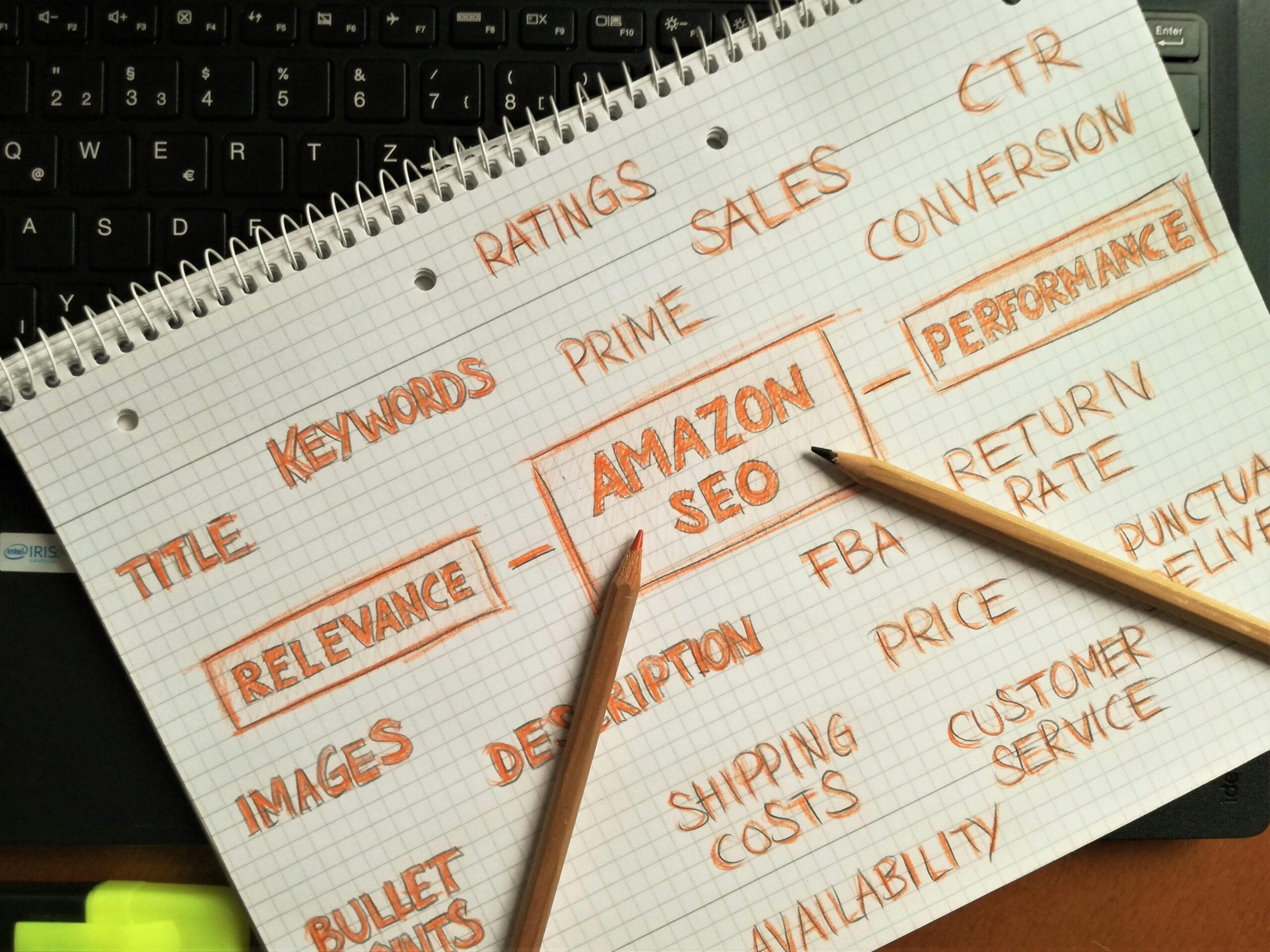
Once I stripped away all the noise and complexity, starting an Amazon business came down to six clear steps.
Not easy steps, but clear ones. Here is how the process actually looks when you simplify it.
Step 1: Choose your business model. The first decision is choosing how you want to operate. FBA for systems and scalability. Dropshipping for low-cost entry. Wholesale if you have capital. Merch if you are creative. Pick one and commit to understanding it deeply before considering anything else.
Step 2: Research profitable products. This is where direction comes from. Use Helium 10 or Jungle Scout to analyze demand and competition. Use Google Trends to understand whether interest is growing or declining. Apply a simple filter: consistent demand, manageable competition, room for healthy profit. If a product does not pass all three, move on.
Step 3: Create your Amazon seller account. Go to Amazon Seller Central and choose your plan—Professional for serious sellers or Individual if you are still testing. This is the official starting point. It is straightforward but marks the transition from planning to doing.
Step 4: Source your products. Depending on your model, this might mean working with manufacturers through Alibaba for private labels, finding wholesale distributors, or setting up supplier relationships for dropshipping. Quality and reliability matter as much as price at this stage.
Step 5: Build and optimize your listing. Invest real time here. Write a clear, keyword-informed title. Get professional or high-quality images that show the product from multiple angles in real use. Write descriptions that remove doubt and build confidence. Price strategically. This is the basis of everything to come in this listing.
Step 6: Market and improve continuously. Launch with Amazon PPC ads to build initial visibility and sales velocity. Bring external traffic from social media when you can. Monitor your data closely. Adjust based on what is working. Scaling comes after you understand what is already performing, not before.
Once you see it clearly, it is not a complicated process.
The hard part is it takes patience and consistency at every stage. But that’s what makes it worth it because most people won’t stick it out through that learning curve, leaving a real opportunity for the ones who do.
READ MORE – How to Start a Profitable T-Shirt Business from Home in 2026
Frequently Asked Questions
How much is needed to start an Amazon business? It depends entirely on the model. Amazon Merch can be started with zero upfront cost since you only upload designs. Dropshipping can be launched with as little as $100 to $200 for account setup and basic tools. FBA typically requires $1,000 to $5,000 for initial inventory, fees, and essential marketing. Wholesale usually requires more because you are buying in bulk. Start with the model that fits your current budget and scale from there.
How much time does it take to start making some money on Amazon? Merch and dropshipping can sometimes generate early sales within a few weeks, though building consistent income takes longer. FBA and wholesale typically take one to three months after launching before meaningful sales momentum builds because they require setup, product indexing, review accumulation, and listing optimization. Patience in the early phase is not optional; it is part of the process.
Is Amazon e-commerce still profitable in 2026? Yes, but the nature of what makes it profitable has changed. Raw entry and basic execution are no longer enough. What is profitable now is strategic product selection, strong branding, well-optimized listings, and consistent marketing. Sellers who treat it as a real business continue to build strong, sustainable income on the platform.
What is the best business model for Amazon beginners? There is no universally correct answer, but Amazon Merch is the lowest-risk starting point because it requires no financial investment. Dropshipping is also beginner-accessible with low startup costs. FBA is the most scalable long-term model but requires more capital and patience upfront. Choose based on your current resources and your willingness to invest time versus money.
Can I sell on Amazon but without keeping any inventory? Yes. In both the dropshipping and print-on-demand models, you can sell without holding physical stock. In dropshipping, your supplier ships directly to the customer when an order is placed. In print-on-demand (merch), Amazon handles production and fulfillment entirely. These models are attractive for beginners because they reduce financial risk significantly, though they come with their own learning curves around supplier management and design strategy.
How important is it to have my own brand on Amazon? Increasingly important. The Amazon marketplace has become crowded with generic products, and buyers are more discerning than they used to be. Sellers with a recognizable, consistent visual brand identity, a strong product story, and reliable quality consistently outperform generic listings even at higher price points. No need to build a household name. You just need to look more trustworthy and intentional than the alternatives in your product category.
READ MORE – How I Started My Affordable Web Design Business From Home
Final Thoughts: What Amazon Actually Teaches You About Business
Here is what studying and working in Amazon e-commerce has taught me more broadly beyond just the platform itself.
Building something sustainable online is not about finding the perfect product or the perfect strategy.
It is about developing the discipline to keep improving when results are slow, the patience to let things compound over time, and the honesty to look at your mistakes clearly instead of explaining them away.
Amazon rewards sellers who treat it seriously.
Every step matters more than it seems from the outside: the product research, the listing, the pricing, the reviews, the marketing, and the inventory.
Miss one, and the whole system works less efficiently.
Get all of them working together, and the compounding effect is genuinely impressive.
If you are just starting out, do not let the complexity paralyze you.
Choose a model, do your research, take your first step, and stay in the game long enough to learn from what happens.
That is the real formula, not any particular tactic or tool, but the commitment to keep going and keep getting better.
Amazon in 2026 is not easy money.
But for the people who approach it with patience and genuine intention, it remains one of the most accessible paths to building a real online income from home.
Found this helpful?
Have questions? Drop your questions in the comments below! I read every one.
Thank you so much for reading! Share your opinions and perspectives in the comments below to increase the visibility of this article. Subscribe to She Speaks. Business to get more stories like this one.
Best regards,
Fatima K.
Writer. Mother. Dream Builder. Founder.